KLIMAready Survey Results Reveal Support Needs
A total of 128 Hamburg companies shared their experiences with sustainability and climate action measures. The results show that financing, regulation and human resources are the biggest challenges. At the same time, there is strong interest in greater collaboration.

Hamburg organisations rely on collaboration for a sustainable future
The results of our KLIMAready survey paint a striking picture: across seven Hamburg industry clusters, sustainability has long been more than a buzzword. Numerous companies have already begun actively shaping a climate-friendly future.
At the end of last year, stakeholders from Logistik-Initiative Hamburg, Erneuerbare Energien Hamburg, Hamburg Aviation, Life Science Nord, Maritimes Cluster Norddeutschland, Food Cluster Hamburg and Finance City Hamburg were invited to complete a 16-question survey. In total, 128 participants shared insights into existing and planned measures, obstacles and support needs.
Sustainability is now firmly established within Hamburg companies. The central message of the survey is: we want even more collaboration. Only together can we overcome the challenges and prepare Hamburg for a climate-friendly future. KLIMAready, which brings seven Hamburg clusters together for the first time, offers strong opportunities to share and expand knowledge and advance innovative solutions.Dr Melanie Leonhard, Senator for Economy and Innovation
Climate change and sustainability affect almost all respondents
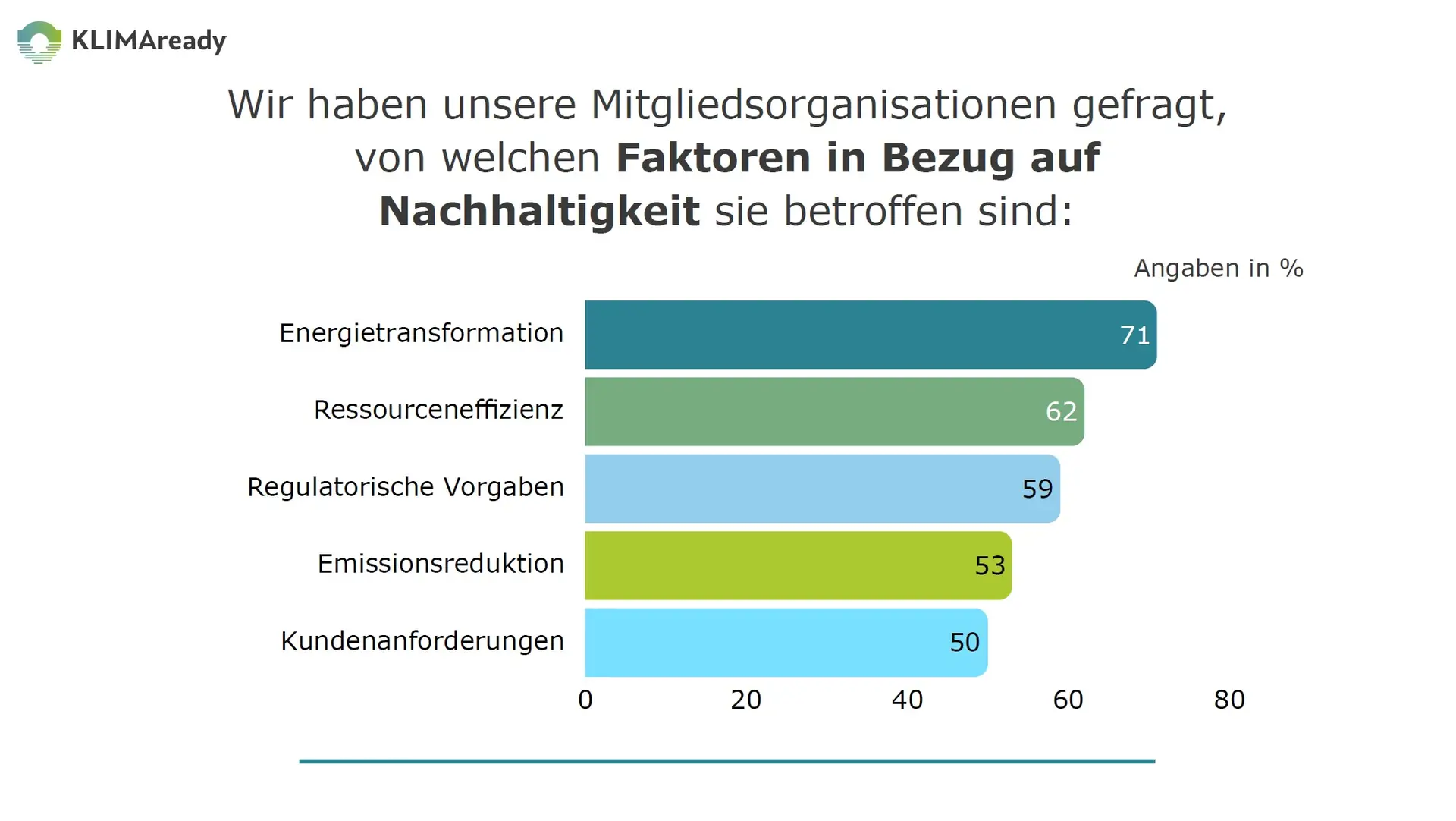
When asked which sustainability and climate-change factors affect their organisations, the most frequent response (71%) was the energy transition, including the use of renewable energy, electromobility and energy efficiency. This was closely followed by emissions reduction (68%) and regulatory requirements (58%). Customer expectations were a decisive factor for just over half of respondents. Technological requirements, such as new propulsion systems, are relevant to around 23% of the organisations surveyed.
Looking at these assessments in relation to company size shows that large companies with more than 500 employees place above-average importance on the energy transition and emissions reduction, whereas small and medium-sized enterprises particularly emphasise competitiveness. Across individual industries, however, the assessments are largely aligned.
Around 9% of respondents stated that they had not yet implemented or planned corresponding measures. The most common activities (67%) concern the use of renewable energy or sustainable technologies for energy generation and use. More than half also reported having developed a sustainability strategy and/or sustainability reports and having trained and/or recruited employees accordingly. Respondents also make use of external support, with services offered by their respective cluster organisations being used most frequently (45%).
Challenges and needs: where companies are looking for support
The top three challenges when implementing climate-friendly measures are additional workload (48%), regulatory uncertainty (52%) and financing/high implementation costs (66%).
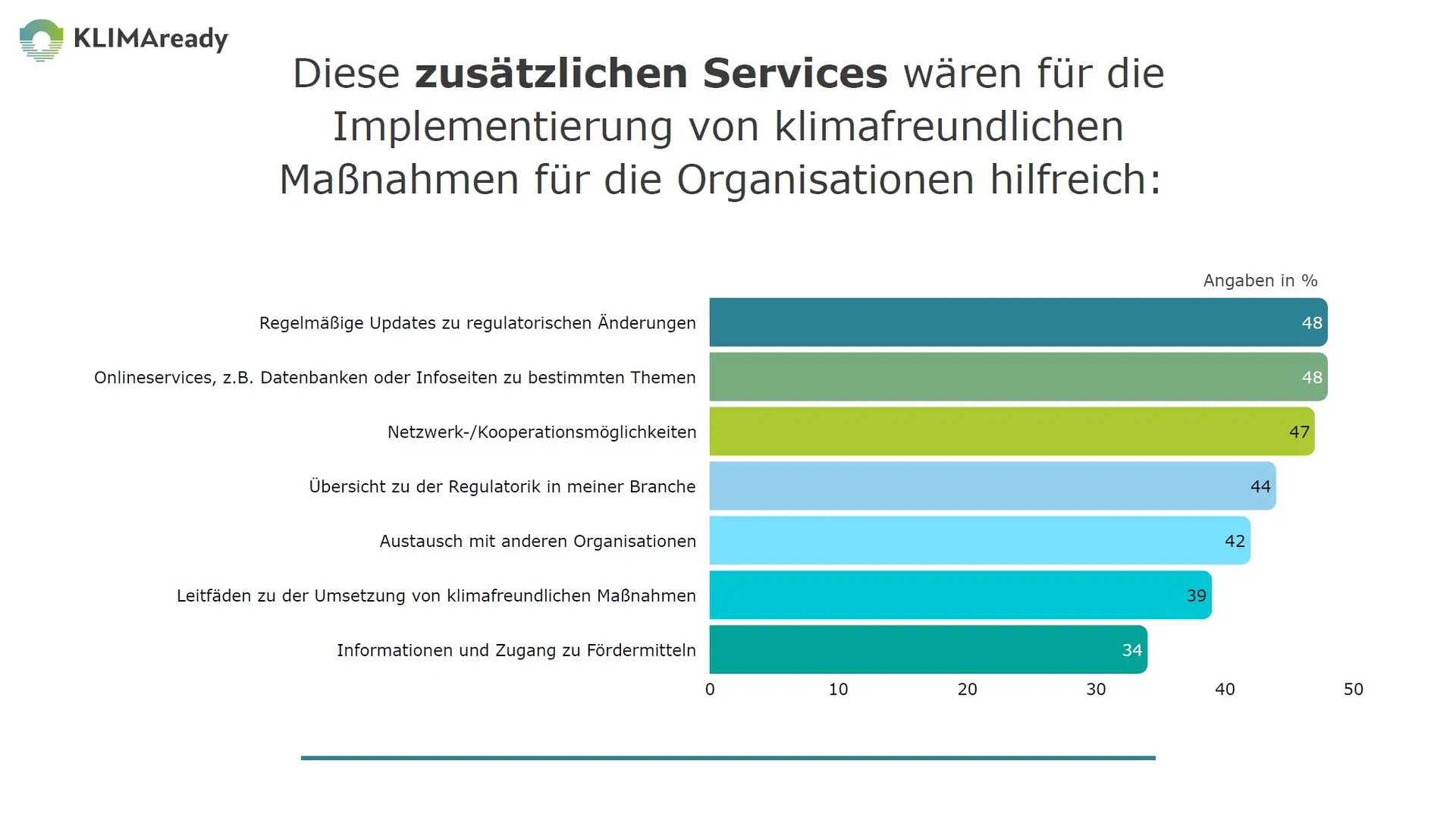
In terms of concrete support from KLIMAready, respondents particularly requested information, networking opportunities and implementation support in areas such as the use or generation of renewable energy, more sustainable mobility, emissions reduction and energy efficiency. They also expressed specific wishes:
- Regular updates on regulatory changes (48%)
- Online services, e.g. databases or information pages on specific topics (47%)
- Networking and cooperation opportunities (46%)
- Overview of regulation in my industry (43%)
- Exchange with other organisations (42%)
- Guides for implementing climate-friendly measures (39%)
Hamburg thinks in networks: collaboration as the key
One clear message from respondents is that collaboration is key. Almost all participants expressed an interest in cooperation. Already, 62% rely on exchange with other organisations to advance the implementation of climate-friendly measures.
A total of 94.5% of respondents said they see opportunities for future collaboration with other organisations. They particularly highlighted the exchange of best practices, joint research projects, cooperation on emissions reduction and cross-sector training/workshops.
How the KLIMAready project addresses these needs
KLIMAready is funded by the European Regional Development Fund and the Ministry of Economy and Innovation of the Free and Hanseatic City of Hamburg. The project aims to build bridges between industries, companies and people. The goal is to overcome obstacles together and identify new paths. A range of measures are planned, drawing both on the needs analysis and, in the spirit of agile development, on experience gained during the project. The next steps planned for the coming months are:
- Launch of the first Cluster Bridge, a cross-sector and agile collaboration designed to jointly identify and assess climate-related topics and develop measures.
- Documenting the insights gained and designing additional Cluster Bridges.
- Developing a website as a knowledge hub with information on regulation, funding opportunities and services for sustainable business development in the Hamburg Metropolitan Region, as well as best-practice examples.
- Planning and implementing events for networking and capacity building.
All of this serves one overarching goal: together, we will become KLIMAready!